What is an XR LED Display? What are the application scenarios?
What is an XR‑LED Display
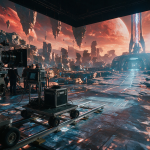
An XR‑LED display is a film‑grade LED display system specially developed for XR virtual shooting (virtual production). It is more than an ordinary large‑format LED screen. It serves both as a shooting background and an ambient light source. Working in conjunction with tracking systems and Unreal Engine real‑time rendering, it generates virtual 3D environments to replace traditional green‑screen shooting.
XR stands for Extended Reality (the integration of VR/AR/MR). The XR‑LED display is the hardware display terminal within this solution.
🧩 Components of an XR‑LED Studio (the structure shown in your earlier images)
- Vertical Background Screen (Main Screen): Curved or right‑angle LED wall that renders virtual backgrounds such as distant landscapes, skies, architecture and outer‑space scenes as the primary background for camera shooting.
- LED Floor Tile Screen: Installed on the ground, it achieves seamless perspective fusion with the background screen. Virtual‑scene ground surfaces extend directly underfoot, delivering ground reflections and continuous terrain, eliminating visual breaks between wall and ground to form a complete virtual space.
- (Optional) Ceiling Canopy Screen: Creates top‑down ambient lighting and starry‑sky visuals to supplement environmental reflections.
The full set of LED hardware works together with camera spatial tracking, the UE5 real‑time rendering engine and synchronization servers. As the camera moves, the engine calculates correct perspective in real time. The background screen and floor tile screen output synchronized imagery. Cameras directly capture footage of actors immersed in virtual worlds — what you see is what you get.
⚙️ Core Differences Between XR‑LED and Conventional Advertising LED Screens
Ordinary LED screens are made for human viewing only. XR‑LED is cinematic equipment designed for camera capture with extremely strict core‑parameter requirements:
- Ultra‑high refresh rate ≥7680 Hz: Prevents black rolling bars, flicker and moiré patterns in camera footage. Typical advertising LED screens only reach 1920‑3840 Hz and produce shooting artifacts.
- Low‑reflective mask: Anti‑glare surface treatment avoids harsh reflective highlights and ensures natural, lifelike lighting on talent.
- High color accuracy, DCI‑P3 cinema‑grade color gamut, 16‑bit‑plus grayscale: Restores cinematic‑quality colors. Light from virtual environments reflects authentically onto actors, props and armor surfaces.
- Genlock frame synchronization and ultra‑low latency: LED imagery is precisely aligned with camera shutter timing. No perspective misalignment or motion smearing occurs as the camera moves.
- Reinforced floor tile screens: Engineered to withstand foot traffic and equipment loads. Color and brightness perfectly match the vertical background screens for seamless visual continuity between wall and floor.
✨ Key Advantages (Compared with Green‑Screen Workflows)
- The virtual environment emits light directly and produces genuine environmental reflections. Reflections on helmets, metallic armor and glass are achieved in‑camera without green‑screen color spill.
- Actors view the complete virtual environment directly, enabling more natural performances instead of imagining scenes in front of a green screen.
- On‑set monitors show near‑final‑quality footage. Much post‑production work is moved on‑site, shortening production cycles.
- Instant one‑click scene switching between outer space, alien planets, cyberpunk cities and more, eliminating physical‑set construction.
🎬 Typical Applications
Sci‑fi film & television production, high‑end commercial spots, virtual studios, live streaming, virtual product launches, virtual variety‑show environments.
Well‑known case: The Mandalorian was shot using this XR‑LED Volume system.
One‑sentence summary An XR‑LED display is a cinema‑specialized LED system featuring seamlessly joined background and floor tile screens. Paired with tracking hardware and real‑time rendering engines, it captures in‑studio shots of talent immersed inside virtual worlds.